
The five parts that matter.
Every automatic movement, from a $100 microbrand diver to a Swiss chronometer, uses the same basic chain of parts. Understanding them makes spec sheets easy to read.
- Rotor: a half-moon weight that pivots freely. Each movement of your arm turns it, and it winds the mainspring through a set of reduction gears.
- Mainspring: a coiled spring in a drum called the barrel. It stores the energy that runs the watch.
- Gear train: wheels that carry energy from the barrel toward the hands, stepping down the speed so the hands move at the right rate.
- Escapement: an escape wheel and a pallet fork that release the gear train one tooth at a time. This is the tick you hear.
- Balance wheel and hairspring: a weighted wheel that swings back and forth on a fine spring at a steady rate. Each swing lets the escapement advance by one step, so the balance sets the pace of the whole watch.
What beat rate means.
The balance swings at a fixed frequency, usually given in vibrations per hour (vph). The two common rates are 21,600 vph, which is six beats per second, and 28,800 vph, which is eight. A higher rate makes the seconds hand sweep more smoothly and can make timekeeping more stable, at the cost of slightly more energy use.
You can see it on the dial: a 21,600 vph watch has a seconds hand that steps in visible small jumps, while a 28,800 vph hand looks closer to a glide.
Why automatics are not perfectly accurate.
A balance wheel is affected by temperature, position, magnetism and how fully the mainspring is wound. That is why manufacturers publish an accuracy range rather than a single figure. Seiko, for example, specifies its 4R35 at between 35 seconds slow and 45 seconds fast per day; the Miyota 8215 is listed at 20 seconds slow to 40 fast. A Swiss COSC-certified chronometer must test within 4 seconds slow and 6 fast per day.
Most watches perform well inside their specification. If yours suddenly gains minutes a day, magnetism is the usual cause, not a broken movement. How to spot and fix magnetism.
Jewels, hacking and hand-winding.
Jewels are synthetic rubies used as bearings at high-wear points. They reduce friction; above roughly 21 to 25, more jewels do not make a watch better, and a count is not a quality score.
Hacking means the seconds hand stops when you pull the crown out, so you can set the time to the second. Most modern movements hack; some older ones do not.
Hand-winding lets you wind the mainspring through the crown. It is useful when starting a watch that has stopped. Not every automatic can be hand-wound, so check the movement before you buy.
Power reserve, in practice.
Power reserve is how long the watch runs from full wind with no further winding. Classic movements such as the Seiko NH35 and Citizen 8200 are rated for about 41 to 42 hours, so they stop if left off overnight and through the next day. Newer designs stretch that: Tissot’s Powermatic 80 is rated for 80 hours, enough to sit through a weekend. More on power reserve.
Automatic, manual or quartz?
A manual (hand-wound) watch has the same movement without the rotor, so you wind it yourself. A quartz watch uses a battery and a vibrating quartz crystal and is far more accurate, but has none of the mechanism above. The choice is about how you want to live with a watch. Automatic or quartz · Every movement type explained.
Automatics we recommend.

PRX Powermatic 80 Ice Blue
The PRX in its most wanted colour
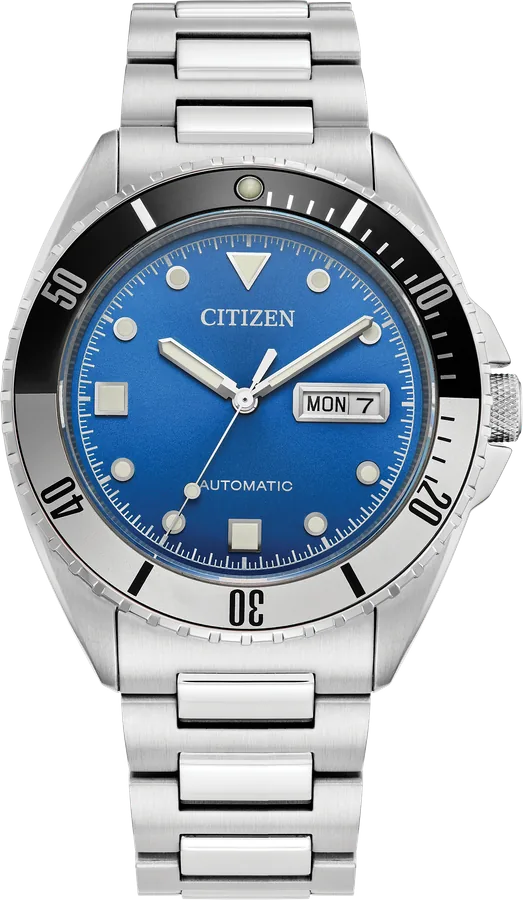
Sport Automatic Blue (NH7530-52M)
A sapphire sports automatic with a retro day-date
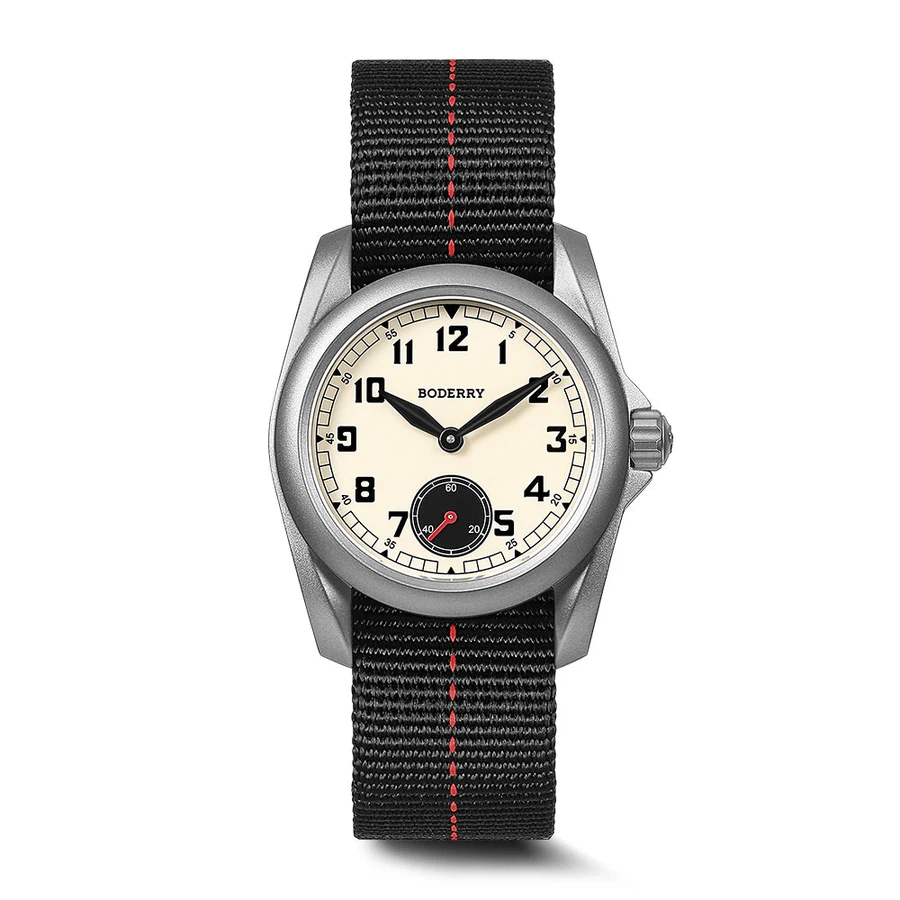
Voyager S72 Cream
Titanium character. A three-day reserve.
A few good questions.
Do automatic watches need batteries?
No. An automatic watch is powered by a mainspring that is wound by a rotor as you move. It has no battery.
Will an automatic watch stop if I do not wear it?
Yes, once its power reserve runs out, usually after 40 to 80 hours depending on the movement. Wind and set it when you put it back on.
How many times should I wind an automatic watch?
From fully stopped, around 30 to 40 turns of the crown fully winds many movements, but this varies. Check your watch’s manual; most automatics cannot be overwound because a slipping clutch protects the mainspring.
Is it bad to let an automatic watch stop?
No. Letting a modern automatic stop does not harm it. Some owners use a watch winder for convenience, but it is not necessary.
How we write guides: we explain watchmaking from manufacturer documentation and published standards, and say plainly where numbers vary by brand or movement. Our approach.